
Victor Davis Hanson
American Greatness
The distinguished political scientist Graham Allison, author of the 2015 Atlantic article “The Thucydides Trap,” argued that often in history an established power will stage a preventive war against an ascendant adversary—for fear that otherwise it will soon lose its primacy.
His title derives from two passages in the first book of the ancient Greek historian Thucydides (460–400/395? BC), author of The Peloponnesian War.
Thucydides, on these two occasions, felt that the most likely cause of the Spartan-Athenian war (431–404) was Spartan fear of an increasingly powerful rival Athenian empire. That anxiety supposedly prompted a Spartan preventive invasion before, so Sparta believed it would be insidiously eclipsed by its more dynamic Athenian competitor.
Allison and others argue that this paradigm now applies to the United States. It is the supposed jittery established power—and a rising Communist China is the upstart contender. His theory implies that the US might, like Sparta, take provocative steps to abort an inevitable Chinese-dominated world.
There are, however, a number of problems, ancient and modern, with Allison’s intriguing thesis.
First, Thucydides left his history unfinished and unrevised. And so often he offers analyses that are contradicted by his other observations elsewhere in history.
For example, in a variety of passages, the historian contrasts the antithetical Spartan and Athenian systems. He does this to explain why they often fell into disputes even before the Peloponnesian War—such as after their shared successful effort against the Persians (480–479) and during the prior fifteen-year conflict, the so-called “first” Peloponnesian War (460–445 BC).
Sparta was oligarchic, Dorian, and an infantry power. It was a parochial landlocked society, overseeing a vast population of enserfed helots. Athens, in contrast, was radically democratic, Ionian, and slave-owning, with a huge navy and maritime empire. It was as cosmopolitan a city as Sparta was a closed society.
So there were many long-standing, deeply rooted differences that sparked tensions and war, besides the Spartans’ fear of Athenian expansionism.
Moreover, the time-honored hegemon Sparta won the war, as do most such established superpowers.
The centuries-long dominance of the British Royal Navy explained why Britain was able to stop the upstart Hitler’s blitz and planned invasion of Britain. The economy and resources of the established US took only four years to crush the aspiring new hegemon, imperial Japan.
The same was true in the Cold War, when the US wore down a supposedly ascendant Soviet Union.
Often, it is not even the traditional superpower that instigates the wars that they win. It is just as common in world history for a would-be new power to initiate hostilities or launch a war against a traditionally dominant nation. Compare the foolhardy conflicts that they often lose, like the wars, either hot or cold, that would-be hegemons Germany, Japan, and the Soviet Union all started against the dominant US.
Moreover, great-power rivalries between a veteran powerhouse and a newcomer often never result in war. The US gradually replaced the British Empire in the postwar era as the global policeman without a war. Britain and France peacefully accepted the “German miracle” of postwar West Germany’s ascendance as Europe’s dominant economic power.
A better prognosticator of the likelihood of war, ancient and modern, is whether the adversaries’ political, economic, and cultural systems are similar or antithetical. If they are different, the chances of war between such opposing systems mount. (Contrast Athens and Sparta, Nazi Germany and Britain, imperial Japan and the US, etc.)
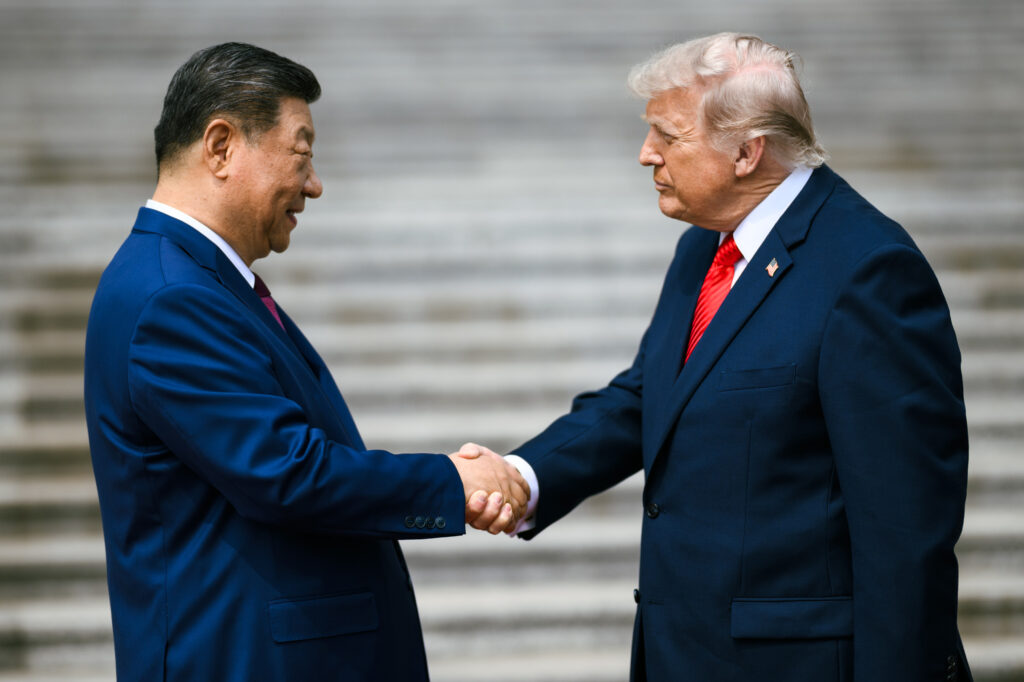
Finally, how does the supposed “Thucydides Trap” apply to the US and China?
Despite the recent summit hype, not at all.
America is the traditional global power but is also radically ascendant; China is the upcoming challenger but is currently stumbling.
In all the key indicators—oil and gas production, food self-sufficiency, fertility, innovation, weaponry, constitutional stability, personal freedom, university STEM programs, naval carrier groups, air power, nuclear arsenals, space exploration, GDP per capita, and alliances—America continues to widen its advantages.
Thus, the US, as the status quo superpower, has no need to launch a preventive war against a struggling China.
Why?
One, Beijing is not ascendant vis-à-vis America in the key areas that count.
Two, both countries are nuclear powers, and neither wishes Armageddon.
In sum, there is historically no universal “Thucydides Trap” phenomenon of asymmetrical rivalries leading inevitably to war.
The titular “trap” is not even a complete analysis of all the major causes of the Peloponnesian War, as outlined by Thucydides himself.
Moreover, ascendant powers start as many wars as do fearful, stronger, and established nations. And the upstarts more often than not lose their risky gambits against the established powers.
So, we are not caught in a “Thucydides Trap.” We can prevent any challenges from a weaker China from escalating to war through deterrence, alliances, maintaining a balance of power, occasional respectful negotiations—and our far greater power and resilience.
I am very excited to call myself a student of VDH. Thanks You Sir.
Love it VDH!
Well said, Victor.
The Chinese officials like to cite so-called ‘Thucydides Trap!’ because firstly it depicted China as a rising great power which seem to be competent to challenge America to satisfy their vanity. Secondly they impute the likelihood of war between the two countries to the jealousy of the established power to make man overlook the aggressive actions China had done to the US. In a word, the supposed ‘Thucydides Trap!’ make China sound great and innocent.
Great analysis and lesson.
China is not in a credible position to contest US dominance at this point in history. What is terribly obvious however, is that the “leadership” of the US, the deep state and establishment toads who want to control everything, are willing to make almost any “sacrifice” to protect the ongoing scam. People like McConnell and Thune are an absolute disgrace to the heritage of our nation, but they are seemingly in charge.
I agree that China could not win an outright war with the US but they are doing all they can to infiltrate and establish control in our country, footholds to be exploited such as sending hundreds of thousands of students to our universities to steal intellectual property, buying hundreds of acres of our farmland near military bases to spy on them, buying our food processing plants to control our food supply, even establishing Chinese police stations in cities like New York, putting bio labs in different places across the country that contain infectious disease samples for whatever purpose and probably quietly using other invasive tactics that we have yet to discover.
“The Thucydides Trap” seems a bit of a hi-falutin term for the well known fact that old bulls will drive away young bulls until the time comes that they can’t.
In a letter to the editor of the WSJ today, a fellow said that there WAS a kind of Thucydides trap – when Athens decided to invade Sicily and failed. This weakened Athens and led to its loss to Sparta. A lesson for China about invading islands?
Yes, VDH is a top of the line Historian. We should all be thankful for his contributions and knowledge. I would have loved to studied under Professor Hanson.
China’s total fertility rate sits at roughly 1 birth per woman, which is roughly half the required replacement rate of 2.1. It should worry more about the “Parent Trap,” than a Thucydides trap…
A couple days ago I saw the article Graham Allison of the Atlantic, and those recently quoting his work, and immediately thought wait till The Victor sees this. I chuckled silently to myself and thought of Pee-wee Herman and Mike Tyson, the greatest mismatch. Now, a joke. a challenge re, Peloponnesian War. Who would fall into the exact “Thucydides Trap,” ?Ah, Allison, ha-ha! VDH literally wrote the book. Do not bring a ‘pea’ shooter to sword fight.
It reminds me of Roman tailor Eumenides, who met his friend Euripides with a torn tunic. Greeting him “Eu rip a dees ?” “Yes” says the fellow,
“Eu mend-a these?”
Thanks VDH, long-time fan, 2003 saw you on C-span w/Brian Lamb,
you even had hair.
Imperial Germany felt it was falling behind, which helped lead to WW1. It feared Czarist Russia’s industrialization, among other things.
Yes, fellow admirer here.
Victor Davis Hanson is the established and ever ascendant superpower of classic societies and conflicts. Graham Allison of the Atlantic, and those recently quoting his work to describe the American-China relationship, have just been schooled by a master.
There are few commentators I admire, but VDH is certainly at the top of the list. On a topic such as this, I admit I started reading with anticipation that class would be in session. I was not disappointed!