
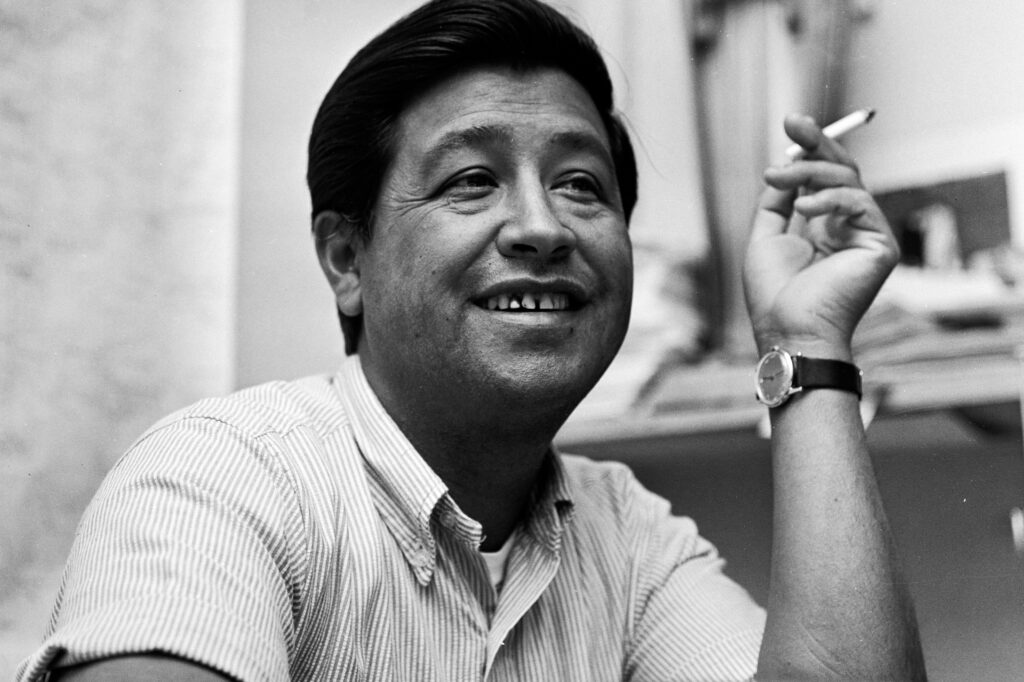
Victor Davis Hanson
American Greatness
Cesar Chavez, founder of the United Farm Workers, eventually became the symbolic leader of the entire Mexican American community of the 1960s and 1970s. Indeed, he was eventually enshrined in the pantheon of modern leftist activists and civil rights leaders alongside Saul Alinsky, Martin Luther King Jr., and Betty Friedan. His Chavez Foundation today emphasizes Chavez’s saintlike status as “a genuinely religious and spiritual figure.” His Tehachapi redoubt remains a national monument.
In public, Chavez stressed nonstop his common-man roots, his strong Catholicism, and his devotion to wife and family, and thereby turned the struggle to provide a livable wage and humane working conditions for farm workers into a broader civil rights movement—led by the Christlike martyr Cesar Chavez himself. He carefully constructed an image of the long-suffering moralist, at odds with greedy capitalist “growers,” whom Chavez often publicly said he loathed.
Chavez frequently quoted Gandhi and Martin Luther King Jr. and went on well-publicized fasts and nonviolent marches. The Camelot Kennedys made yearly hajjes to California to meet with the holy man. 1960s college students ensured that table grapes were banned in campus cafeterias.
In 1971, as a bumbling freshman farm kid entering UC Santa Cruz, I can remember being confronted my first day on campus by screaming students outside my dorm door for bringing to my new room a tiny box of grapes I picked on our small 120-acre farm.
Trying to explain to furious (mostly) wealthy white kids from Los Angeles that family raisin farming had little to do with the labor fireworks over table-grape production in Delano was a waste of time. To these suburbanites, Chavez was a god. And anyone anywhere who grew any type of grape for any reason was Satanic. So effectively had Chavez spread his gospel of evil farmer oppression to the estates of Brentwood, Palos Verdes, and Malibu.
Yet even then, there were always elements of the mythical Chavez that did not quite ring true. The supposedly nonviolent Chavez sent his toughs down to the southern border to form a “wet line” to stop and sometimes assault illegal aliens—in a way that would make ICE today look tame. But assaulting such “scabs,” Chavez preached, was necessary to ensure cheap nonunion “strikebreakers” did not drive down his union’s wages.
Rumors in small farming towns swirled—and were tossed off as “grower” lies—that he was a serial adulterer with a string of female liaisons, an image at odds with his carefully cultivated shy and introspective persona.
Nonviolence was his ostensible Catholic-Gandhian creed. But, in reality, his union strongmen salted packing-house driveways with nails, sometimes rushed into the fields to interrupt harvests and drive out workers, sabotaged produce shipments, and used illegal secondary boycotts. A table-grape vineyard besieged at harvest by an army of UFW union strongarms was a frequent and scary spectacle. All that was to be justified for La Causa—the effort to accord farm labor the same rights enjoyed by other union workers.
Despite the rhetoric, most of the table-grape growers of Delano in the central San Joaquin Valley whom Chavez fought were not so easily caricatured as evil billionaire corporate predators. Most were successful family-run farms and packing houses, founded in the Depression by tough first-generation immigrants who came with nothing from Sicily, Croatia, and Serbia.
The private Chavez’s own authoritarian habits and intolerance only grew more severe as his inept union leadership and forays into socialist utopianism lost members and misused state and federal funding. Finally, Chavez brought on the violent, wacky Synanon cult to indoctrinate his top echelon through bizarre group therapies, characterized by screaming sessions of profanity and ridicule. Synanon kooks as Chavez’s enforcers did not go over well with either his college-educated white leftist lieutenants or his inner circle of long-serving traditionalist Mexican American deputies.
Chavez’s growing paranoia and his hounding of “disloyal” union subordinates coincided with the late 1980s and 1990s, when farm mechanization, open borders, radically improved farmworker conditions, higher pay, and the changing nature of California agriculture had largely made the once-feared Chavez UFW irrelevant.
No matter—following his premature death at 66 in 1993, Chavez was canonized, as his postmortem reputation reached angelic status. There is hardly a major California city today that does not have a street named after him. His name is emblazoned on state and federal buildings. His birthday, March 31, at least for now, is still a California holiday. There is a USNS Cesar Chavez cargo ship. Chavez statues dot California campuses. Until recently, few have ever questioned the canonization of Chavez.
But this past week’s recent disclosures—long known among his inner circle and always suppressed for the supposed greater good of the union movement—have revealed that Chavez was a hero with feet of clay.
His top aide, the now-95-year-old but once fiery Dolores Huerta, has just revealed she was raped in a grape field by her boss over a half-century ago. And she was coerced into sex on another occasion, along with being sexually and emotionally abused by Chavez. Two of her own children were fathered by Chavez—a secret kept for over sixty years.
Yet the most disturbing revelations were that Chavez sexually molested and groomed at least two small girls, both reportedly during their preteen and underage teenage years. Some of his victims are now in their sixties. What was once whispered is now a disturbing confirmation of the dark side of the so-called humanist Chavez and the trauma he inflicted on the most innocent and vulnerable.
Further disclosures and victims are promised, but for now, Cesar Chavez, iconic hero of the oppressed, may well have been a longtime pedophile, chronic sexual abuser, and rapist—in other words, an oppressor on the wrong side of the victim/victimizer binary. How and why these dark secrets were kept hidden reflects the cult of Chavez holiness, the fear of retribution from the St. Cesar industry, and the moral bankruptcy of the Left.
So the embarrassed Left has gone into hyperdrive to separate from its fallen hero, rather than seeking to defend him. Why?
The disclosures did not come from far-right conspiracy theorists. The charges arose from among his closest and most intimate union associates, who were no longer willing to remain silent and perpetuate the decades-long myth. And their stories surfaced initially only from the investigative reporting of the left-wing New York Times.
No one from the Chavez inner circle has come forward with angry denials. Instead, they are either silent or quietly confirm the victims’ narratives that Chavez’s abuse was a well-kept secret in Chavista circles for decades.
After the #MeToo movement and the political weaponization of the Epstein files, the Left established the precedent for all others that mere allegations of sexual harassment earn mandatory political and social erasure, characterized by Soviet-style name-changing, statue-toppling, damnatio memoriae, and the complete eradication of the fallen hero from the public consciousness. Indeed, already, impending Chavez Day festivities have been canceled and his statues on campuses hooded.
The Left, however, which had even stripped the names of liberal icons like Woodrow Wilson and Earl Warren from iconic campus buildings for their purported racial offenses, will have some difficulty applying the same unpersoning methods to Chavez. After all, in today’s terms, he was a Latino champion of the DEI movement and not a proverbial “old white guy” on the wrong side of the victim/victimizer ledger. Will that fact save Chavez from being relegated to Harvey Weinstein status?
So, the Left is on the horns of a dilemma. It was one thing to erase a liberal jurist like Earl Warren or a progressive president like Woodrow Wilson, given that they were white guys whose alleged sins came from their “privilege” as white males.
But what does the Left do in these cases of intersectional conflicts of interest, when a noble male of color is accused of violating noble women of color, and there is not a white male oppressor to be found amid this sordid mess?
In the case of the civil rights giant Martin Luther King Jr., it had long been alleged by his close aide Ralph Abernathy that King watched—and did not intervene, perhaps even egging on the attacker—when one of his subordinates raped a woman in a hotel room. And his biographer David Garrow has reluctantly chronicled the dark side of Reverend King as a promiscuous serial adulterer who, again, allegedly got violent with some of his liaisons.
Yet for the Left, the world retains a Manichean divide between all the noble oppressed, now defined by their innate race, gender, and sexual orientation, and all the evil oppressors, mostly white, male, and heterosexual.
Leftists toppled or removed statues of genuine heroes like Christopher Columbus, Ulysses S. Grant, Thomas Jefferson, Theodore Roosevelt, and George Washington; what, then, will they do with Chavez, who, as a figure of the modern age, was well aware of the norms, mores, laws, and customs of the late twentieth century?
The Left has ended any talk that a person’s life is a sum of good and bad, to be weighed somehow one against the other. In their past record of blanket ostracism, they were incapable of assessing anyone outside their ideological circle as a terrible private person, but one who, nevertheless, as a public figure, did some good things, much less consider the context of the times in which the fallen hero had lived.
But will they then apply that reductionism to Chavez or King, or even to John F. Kennedy or Bill Clinton?
Or will they revert to keeping quiet, as they surmise that, in order to make a good progressive omelet, inevitably even the most hallowed leftist saint regrettably sometimes callously breaks a few eggs and so should be forgiven for the collateral damage of a few utterly ruined lives?
I am amazed this is new again. These rape claim were brought up back 30 plus years ago when the City of Austin was renaming 1st street. I seems like it was all hushed up quickly. Now here it is as new big news.
Here in Austin, we will have to rename Cesar Chavez st back to First Street, or maybe Davey Crockett street. I think he’s still considered a hero here.
Well done, Mr. Hanson. As a central valley son of a farming family, you have expressed with crystal clarity many aspects of Cesar Chavez and the left. Thank you.
You nailed it VDH. Growing up in the Central Valley and working in ag in the 60’s, I saw it first hand. I always had doubts about the spurious claims made by Chavez et al. Being in the middle of it gave me great perspective on what was said. I’ve always had my doubts and now they were confirmed. Truth sometimes gets delayed but never lost.
VDH,
With all the revisionists history going on.
Repetitions beget reparations, just find a reason to forget about history. Come one come all there’s money to be had.
This paragraph in your essay says it all.
Leftists toppled or removed statues of genuine heroes like Christopher Columbus, Ulysses S. Grant, Thomas Jefferson, Theodore Roosevelt, and George Washington; what, then, will they do with Chavez, who, as a figure of the modern age, was well aware of the norms, mores, laws, and customs of the late twentieth century?
VDH, very good exposure of the false man that Chavez was. I grew up in Visalia and read many news accounts of the wonderful (not) UFW, but I do not recall some of the violence that you told your readers.
The saddest thing of all is that the left venerates so many evil men, and Chavez was certainly evil…..
DB:
Very surprised to hear that. I went to St. James on 90th. Cesar Chavez and the UFW were talked about a lot among the nuns and lay teachers. Chavez had a huge impact and he had been inspirational for many. It’s very sad that another liberal icon turned out to be an extremely flawed person.
Along with the discredited moral pillars of the Left, don’t forget LBJ and his crass ways. He interacted with the press while defecating. When asked why he should get his way on a certain piece of legislation, he reportedly whipped out “Jumbo” and said “because I have this”. Referred to African Americans with the ‘n word’. RFK Jr and JFK passed Marilyn Monroe back and forth, and JFK asked his teenage secretary who couldn’t type to sexually relieve one of his aides.
Not many unionized farmworker jobs left to defend.
Just another of many sad, sick, amoral examples to prove the entire leftist ideological structure is based on feet of very feeble clay. Delusional, immoral, self serving, elitist, corrupt, in essence evil manifested.
OLD NEWS regarding CC. Now why is Harvey Mik honored with his name on the SF International Terminal?
The epigram from Patty Hearst’s memoir of her ordeal, EVERY SECRET THING, is from the Book of Eccliastes. “For God shall bring every work into judgment, with every secret thing, whether it be good, or whether it be evil.” I don’t suppose that what has occurred with Chavez can be described better than that.
MM:
The nuns at Holy Cross in Omaha never brought up CC and I don’t think the Jesuits at Creighton Prep did either. I have just the vaguest of recollections about table grapes and the UFW.
Ha ha ha .
What a bunch of goy suckers.
I was expecting Cesar Chavez to be cancelled.
He was so undeniably an enemy of illegal immigration and illegal immigration, which is now a religious cause for the Left, that Chavez’s sainthood had to be destroyed by the Left itself.
I expect Martin Luther King and John F. Kennedy to be next.
Martin Luther King’s famous quote “judged by the content of their character and not by the color their skin” is routinely thrown in the faces of the DEI Left by conservatives and the Left has no good reply. The only thing they can do is to destroy the author of that quote.
Similarly JFK was the type of center Left Democrat in 1960 who would be considered far right by today’s MSM and Democratic party (JFK was further right than that “fascist” Bill Maher”), that his canonization as a Democratic hero has to be destroyed.
Hmm, I wonder if that is why People magazine recently (3/14/26, 4 days before NYT’s Chavez expose) had an article entitled: “What We Know About John F. Kennedy’s Alleged Mistresses”. The article just recaps old news. There is no new book coming out about JFK offering some new nuggets. On the surface makes no sense. People magazine has to drive circulation with NEW salacious scandals. In fact, many of the article’s comments are puzzled by why People is recycling old scuttlebutt.
The best explanation I can give is that the Left has been given marching orders to decanonize JFK and the Camelot myth. People magazine is firing the opening salvo of this campaign.
Also, I remember my grandfather, who was in the business, actually bringing up the name Huerta as someone they could deal with. And, how after coming to agreements with her, Chavez would then go the the cameras and renege…..I guess he never respected her.
Lived it too. As my Sicilian family name was enough for gullible college student to harass even the department secretaries at Sacramento State College because my parents were professors there; and my parents receiving death threat phone calls at night…made quite the impression on me as a pre-teen.
“…So, the Left is on the horns of a dilemma.” The Old Left may be grappling with it, but the New Left knows what it is doing: Discredit Chavez whose anti-illegal immigration stance (he begged Congress to seal the border!) cannot be used in the racialized mass amnesty and instant citizenship fight the left has planned for the 2030s.
The ability to hold up Chavez as an example of border rationality can now be blunted with, “”So you agree with a groomer-molester and rapist?” — just as Washington, Jefferson, Columbus have no traction with lefties for having been slavers and conquerors.
I cannot see things otherwise. It reminds me of the 2000s when environmentalist hypocrisy regarding “mass immigration vs. population bomb” became so obvious that a certain leftist billionaire who’d given the Sierra Club $200 million threatened to cut his largesse if the Club did not change its restrictionist position.
Where is the Sierra Club today? Like Chavez, irrelevant, and soon a footnote, as the real goal of racial reconstruction for the United States takes shape.
I would also suggest that Dolores Huerta is as fanatical as Madame Defarge. She kept her mouth shut for 60 years, throwing her own children under the bus until the signal was given that the moment to push for a borderless U.S. that will be culturally re-classified as a Lain American nation had arrived. She’s the real Bad Bunny. Woke is not gone — it is waiting for the 2040s and white minority status.
Yup, his lackeys came to my HS in Ma. In the early 70’s to brainwash us with horror stories of the migrant laborers abuse by big farm corporations which was BS. The teachers organized this lecture and bowed to the young radical speaker. Truly pathetic as I look back and typical of the leftist Heroes of the 60’s and 70’s. Every time I hear the leftists screaming that Trump is a pig I laugh and remind them of the sexual exploits of their heroes JFK, RFK and Teddy, LBJ, MLK, Clinton and tell them Trump’s a choir boy compared to their leftist Icons.
Dr. Hanson – as a scholar justly proud of your precise use of language, it surprised me to see you use the label “pedophile” after describing Chavez’s alleged sexual abuse of “preteen & underage teen” girls. I must also admit I have previously used the same shortcut when writing about Epstein (though his youngest victims were allegedly 12-14) before learning better. I’m now insufferably pedantic about this.
A pedophile is a person sexually attracted to pre-pubescent children. There is a generally-acknowledged classification system but it has yet to be incorporated in the DSM:
• Pedophile: primary sexual interest in prepubescent children, roughly under 11 or before puberty
• Hebephile: primary sexual interest in early pubescent youths, roughly 11–14
• Ephebophile: primary sexual interest in mid-to-late adolescents, roughly 15–17
This is only top of mind because of how the term “pedophile” has been abused when discussing Epstein. For those who will jump on my observation with, “Yeah, don’t be an apologist for perverts,” I’m making no defense of any practices (though when 18 & lusting after my 17-yo gf I would not have considered myself an ephebophile). I merely seek linguistic precision that aids understanding.
I am overjoyed that you have seemingly survived your recent health crisis. I hope you are sharing your wisdom with us for decades to come. As I told you on a NR cruise, you’re pretty smart for a guy who drives a tractor.
I also grew up in your community. I went to an all girls Catholic school in another state & remember going to the chemistry teacher (nun) for some help. When she found out I was from Central CA, she started telling me how wonderful CC was. I disagreed & told her what was happening in the valley & that My younger brother worked as a guard in a vineyard. She was pretty angry with me.
California Changes
State legislative leaders moved to rename César Chávez Day as Farmworkers Day.
The California Assembly reportedly advanced the renaming bill.
The State Senate’s annual resolution honoring Chávez was halted.
LAUSD moved to remove Chávez’s name from two campuses.
Los Angeles renamed its city holiday to Farmworkers Day.
Los Angeles County began exploring renaming its holiday plus parks, streets, facilities, monuments, and related civic imagery.
San José canceled its César Chávez celebration and began reviewing named locations and monuments.
Bakersfield halted an effort to rename a street for Chávez.
Other California cities and agencies were reported to be reviewing streets, buildings, and public honors.
Plus, the UFW movement he started is all but dead.
Probably not the ending Chavez was hoping for.
Another leftist icon with feet of clay. Once again demonstrating the impotence of conservative voices to oppose the destruction of morality & decency. No one should be surprised, it continues to this day with Mike “hands up/dont shoot” Brown & everyone’s moral compass St
George of Floyd.
I like to have accuracy whenever trying to dismantle undeserved hero worship. Specifically, the section about the Camelot Kennedys and their supposed ‘yearly hajjes’ to visit the ‘holy’ man. I’d question which group of Kennedys may have made the visits because of when Chavez became ‘notable’ enough to be a benefit to them. I don’t think he wasn’t a big enough name until after Jack was assassinated and Camelot was no more. Bobby on the other hand, he and CC were definitely like minded.
There was one time I remember when CC was appearing at an event when his big stretch Caddy came up. He got out of the car, took off his suit coat and removed his tie – for effect, before he walked down the street to the podium where he was going to preach. His wrinkled shirt was open at the collar and the stone washed jeans made him out to be an entirely different man than the one that arrived in the Caddilac.
I worked in lettuce fields ‘58-‘61. Started when 12 years old and legally could work. I remember getting my SS card and working long hours. Most in those days were in the bracero program and worked to earn more money in a day than a week in Mexico.
My favorite person to talk to, I wasn’t fluent in Spanish, was an interpreter in Mexico City for United Airlines.
There were inequities in how they were treated but they were paid (half of their pay was taken for room and board) the boys I worked with learned to show up work hard eat what was provided and get along with the crews.
There were inequities Salinas valley families had “labor camps” to give laborers a safe and mostly clean place to sleep eat and fellowship.
I’m not saying that is the answer now but I did this until my Sophomore year in high school.
Something’s will never be the same some changes are for the better some not.
Thank you for the sharing your experience with UC Santa Cruz.
Love to you and family
Jer Lingo
Dust bowl baby 1944
Victor is not a man given to fantasy. When he writes that the Chávez myth is cracking—from within—it deserves attention.
Those of us from the Valley remember the reality beneath the mythology. Chávez was never just a symbol. He was a power center. And Keene—La Paz—was where that power lived.
i worked in Keene during the late 1960s with the KCFD fire crews. At that time, the Chavez monument-to-be was just an abandoned tuberculosis sanatorium.
What began as a union-funded headquarters is now a federally supported monument. That’s the shift that matters.
If the emerging accounts from his inner circle are even substantially true, then we’re not dealing with minor contradictions. We’re looking at a complete collapse of the moral narrative that justified his elevation in the first place.
And that raises a simple question:
Why are taxpayers funding this?
We’ve seen statues fall and names erased for far less. The precedent is already there.
No one is arguing to erase history. But federal endorsement is not the same thing as historical preservation.
If Chávez’s legacy is as compromised as it now appears, then Keene should remain—but on private terms.
Let the full story be told.
Just don’t send the bill to the public.
By the way, I also worked in the fields around Arvin picking grapes. We did not appreciate Chavez and his goons.
I grew up in southern Idaho on a farm(1960-70’s), raising a couple of crops that needed migrant help during the season. My dad would watch the news coming out of the central valley of California. He was worried the movement would spread to Idaho. Thankfully, it never did. The migrant crews that we hired were from Texas. Those crews were not to excited about all the ruckus in CA. It was a distraction from work.
Lived it, growing up in the Central Valley.
Tell that story to my Father-in-law who was a production manager out in the fields being shot at during the farm worker’s so called peaceful movement. Always remember there are two sides to every story, and most Saints aren’t that saintly!
I looked up the psychological term “cognitive dissonance” and there, was a picture of Antifa staring at a Cesar Chavez statue…
Chavez has two marks against him which make him a less than perfect icon for the left. First, as Dr. Hanson explains in this column, is the string of sexual misbehaviors. Second, as is briefly mentioned in the column, is the fact that Chavez was, to put it in the most mild terms, not an advocate of open borders. Since the 1990s, The Left has realized that their only real path to power is to import as many D voters as they can from poor regions of the globe. His opposition to open borders, because of the effect on UFW employment environment / wages, does not serve The Left well. They are going to discredit him using the first issue (sexual misbehaviors), because of the second issue (opposition to open borders).
Another icon of the Left revealed. I have a significant case of schadenfreude. The sanctimonious Left has zero credibility with me and hopefully with millions of others. Truth always wins out.
From my childhood in the 1970s, I can think of no saintlier figure than Cesar Chavez. At my parochial school in Omaha, Nebraska, he was venerated. The nuns at the school inculcated the Chavez message. We, too, did not buy table grapes – or at least not those hearty bunches that could be shipped by rail thousands of miles. There were prayer vigils held for the UFW. Chavez was a hero and cited in many a guitar-mass. As you note, sadly, truly feet of clay.