

What Obama doesn’t understand about human nature.
Deterrence makes someone not do something. A parent promotes good teen behavior not just by providing cars and smartphones, but also by the explicit specter of graduated punishments that an adolescent does not wish to repeat, and thus chooses instead to abide by the house rules.
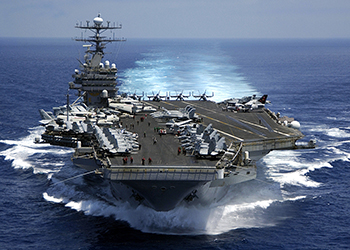
In terms of world affairs, a clear display of overwhelming military strength, and the real probability of being willing to use it, remind would-be aggressors not to start stupid conflicts — given that the possibility of winning something through war is overshadowed by the risk of losing far more. A world where everyone knows the unspoken rules as well as the moral and material relative strength and weakness of the various nations is a safer place for all involved.
Or put another way, deterrence, in the famous formulation of the 17th-century British statesman George Savile, 1st Marquess of Halifax, means that “Men are not hanged for stealing horses, but that horses may not be stolen.” Translated, that means that nations do not go to war just over Czechoslovakia, but that other nations are not swallowed up like Czechoslovakia.
When German foreign secretary Arthur Zimmermann, in a notorious 1917 telegram, offered the government of Mexico all sorts of rewards for attacking the southwestern United States and thereby sidetracking American support for the allies on the Western Front, Mexico balked. But its reason for backing off was not that it liked Americans or thought a preemptive attack would be unfair. Rather, President Carranza worried that Mexico lacked the military clout to take American territory. And even if it could have grabbed, say, Texas, Mexico did not have the power to control it — given a rowdy and armed English-speaking state population, one that Carranza worried was “better supplied with arms than most populations.” In other words, the Second Amendment and a frontier attitude helped to deter Mexico from taking up Zimmermann’s offer.
Deterrence hinges on accurate perceptions not just of relative strength, but also of the likelihood of a nation’s using its power. By any military benchmark — economic resources, size of armed forces, quality and quantity of armor, ships, and aircraft — Hitler’s Third Reich in the mid-1930s was far weaker than the combined power of Belgium, Czechoslovakia, France, Great Britain, the Netherlands, and Poland, well aside from the isolationist United States and enigmatic Soviet Union.
Yet Hitler was still not deterred, but systematically continued his aggrandizement. He gambled that his more powerful enemies were not really more powerful because they wanted calm far more than did he — and were not willing to make short-term sacrifices in order to avert long-term catastrophes. Hitler dismissed his well-meaning appeasers as “little worms,” believing that their efforts should earn them contempt rather than gratitude.
In contrast, Hitler saw his own reckless desire to risk war as a force-multiplier of his otherwise puny tank, the Panzerkampfwagen Mark I, his pathetic surface fleet, and his nonexistent heavy bombers. He was right in all his conjectures until 1941, when, intoxicated by a series of cheap border victories, he in delusional fashion attacked or declared war on both the supposedly unprepared Soviet Union and the apparently pacifist United States. The earlier Molotov–Ribbentrop Pact complicity of the Russians and the isolationism of the Americans had masked the reality that both countries were far more powerful than Hitler’s Axis coalition. The Red Army and the United States military would be able to demonstrate that fact in fairly rapid and overwhelmingly destructive fashion — but at the cost of a global war that would take 60 million lives.
In 1979–80, at the height of the Cold War, the United States was clearly the most powerful nation in the world. Yet, over a few months, the Iranians stormed the U.S. embassy in Tehran with impunity and took American hostages; the Soviet Union invaded Afghanistan, and began drawing up plans to deploy dangerous new weapons; Communist insurrections spread throughout Central America; China invaded Vietnam; and North Korea began saber-rattling. The postwar order created by the United States seemed in danger of unraveling.
All the aggressors assumed that President Carter’s past humanitarian professions, his condemnation of the Shah, and his conciliatory policies toward the Soviets had ensured that for a rare moment they might just have more to win than to lose by otherwise risky aggressions — as the United States’ considerable power was judged to have been rendered negligible by its lack of leadership. President Reagan’s efforts from 1981 to 1984 to restore lost deterrence were caricatured as brinkmanship, given that deterrence is easily thrown away but often difficult and potentially risky to restore.
As we approach 2016, the U.S. economy and military still, by any token, give us unquestioned world power and influence, fueled by constitutional stability, rock-bottom energy prices brought about by brilliant private-enterprise fracking, a dynamic popular culture, top-flight science departments in our universities, and technological innovation. That said, since 2009, in both symbolic and material fashion, the U.S. has shed its classic deterrence. And the world is now a far more dangerous place because of this.
President Obama lost the power of deterrence through a variety of unfortunate pronouncements and policies. False deadlines to Iran, false red lines to Syria, and false step-over lines to Russia have all rendered the currency of U.S. admonitions worthless. If Obama were now to lay down a red line for ISIS should it come close to entering Baghdad, would anyone take that threat seriously?
Deterrence also hinges on emotions. Teddy Roosevelt’s legendary advice to speak softly and carry a big stick named both halves of a successful deterrent posture: not to unduly excite thugs with cheap language, and always to be demonstrably better armed than your enemies just in case.
The inverse — speak loudly and cheaply while carrying a visibly tiny stick — is dangerous. When Obama talks trash about Putin behaving like a class cut-up or being hung up on macho shtick, or when he uses his accustomed sports metaphors to write off the threat of ISIS, or brags that he “does not bluff,” the world at first anticipates that such tough-guy bluster is backed by American muscularity.
But when the rhetoric increases, even as the likelihood of consequent action lessens, deterrence is lost. Ridicule ensues. “Lead from behind” in Libya, coupled with the disaster at Benghazi and its cover-up, only added to the impression abroad that something was now quite different in Washington, and thus in the world’s balance of power as well.
The world is full of thugs and creeps who are kept from spreading their thuggishness and creepiness by their fears of confronting overwhelming power. Vast cuts in our military spending – even as Obama added $10 trillion to the national debt – encouraged a global caricature of the U.S. as a soft, entitlement-addicted society in which increased subsidies for the electorate were deemed more important than an overwhelmingly powerful fleet of planes, ships, and ground assets. When Obama promised to end “two wars,” few here or abroad assumed that he meant to lose both, although accepting defeat is always the quickest way to cease fighting.
Such dangerous perceptions abroad mask the reality that the residuals of American military power still dwarf the power of all rivals. General Matthew Ridgway, who turned the Korean War around when he took command in December 1950, supported strong defense not just for the security it ensured, but also for the deterrent message it sent: that a society willingly sacrifices some of its affluence in exchange for the preservation of its values, and its citizenry is all the more ethical and healthy for it.
Symbolism is integral to deterrence. Obama perhaps meant well in his Cairo speech, his Al Arabiya interview, his apology tour, his circumvention of the Constitution to close a treaty deal with the Iranian theocracy, his media-hyped hosting of the deserter Bowe Bergdahl, his administration’s lies about Benghazi, his euphemism campaign of renaming acts of Islamic terror, his monotonous promises to close Guantanamo, his inability to control U.S. borders, and his pop admonitions to Christians to get off their high horse, to capitalists to remember they had not built their own businesses, to investors to quit profiting, and to the police to remember that they were stereotypers and profilers.
But perplexed autocrats abroad only pondered such behavior and asked themselves, “Has any leader of any nation, past or present, so habitually deprecated his own people and country? So why, then, does Obama do that — if not to show sympathy to our similar grievances against America?”
Certainly, Obama’s most venomous vocabulary has been reserved for House Republicans, legal gun-owners, the successful upper-middle class, and those who are not convinced that man-caused global warming is soon to doom the planet. He speaks much less harshly of the autocratic Castro brothers, the murderous Iranians, or the ISIS beheaders.
To restore the Western-inspired postwar order and hold chaos at bay, the next president will have to restore deterrence, both materially and psychologically. And that will be one difficult and dangerous endeavor — made worse by shrill attacks coming from those who have done so much to lose it.

Discussion (15)
Join the conversation. Logged in subscribers avoid the Captcha verification and get priority commenting approvals. No vulgarity, links, or code allowed.
From Witness by Whittaker Chambers, our entry into WWII, only came after the Soviet Union was attacked. The left and progressive fascists who ran America and saw the threat to the ideal socialist society created by Stalin readily rallied to his support. After all, they hoped to turn America into such a socialist workers paradise. And of course, its still what they want to do today.
I've been of the opinion that US Liberal/Progressive Meme only acknowledges one enemy: US Conservatism and its allies. Any enemy of US Conservatism is courted under the general rubric of "enemy of my enemy is my friend" Obama's "reset" with Russia, his outright stupid Iran deal (and ignoring the side deals with the UN that made his nearly toothless deal worthless) as well as his disdain for traditional US allies all point to this.
Without question, Pax Americana was a boon to all mankind. One can only pray for its restoration, in whole or in part.
Counterrorism relies on intelligence but intelligence in Texas makes more sense. The White House has focused on an executive action that would detail who should be considered a high-volume gun dealer, a move that would not formally abuse power. Jeb Bush said of Obama “And to use executive powers he doesn’t have is a pattern that is quite dangerous.” Bush added that gun control measures should be considered at the state level, rather than the federal level. Americas Gun Culture has become a flared up struggle of an arms standoff.
President Obama blames the NRA for the 14 killed in San Bernardino and so do gun culture activists. The President continues to address the Islamic State and the extremist groups that inspired the attack. After 130 were left dead perhaps arming Americans is the answer. Jared Carter
VDH Obama admitted to using cocaine. He will take our guns away. If you were to write a Mexifornia II in a Rise of the Cartel like fashion everything you address would be forth coming. Happy New Year, jwc
From a military standpoint Hitler never felt deterred at the time because the expected response time from Britain or the US would have been very long. Keep in mind that Britain had but a very small standing military, so had the US. Victor's arguments rely on the long term perspective that the US certainly could and did mobilize more military and sustain a longer and larger conflict. Short term, the West had little to show for as a deterrent. I would go so far to argue that certainly the US, then and now, are held back their unique long term potential which makes them overlook urgencies. Agressors understand that. I would disagree that Obama's words so far render deterrence ineffective. So long as the US military's repsonse time remains short, deterrence stays intact. On the other hand Obama's policies toward Iran have all the potential to reverse precisely that situation. As soon Iran has nuclear armed missiles their response time may be equally short, or even shorter within the smaller range of the Middle East. In any event, one should never "believe" in one's own deterrence. It is for the potential agressor to believe in deterrence. The West must make sure, have all reasonable confidence, not belief, that the military is on their feet.
""" FNN: Bill Clinton campaigns for Hillary in New Hampshire youtube.""" Video of the fading grand-master of B.S.--------- A spent life-force, yet still grasping for the blue pill.
Count on the Republicans to nominate the same old Rino candidate and there will be more of the same, as Obama. Really no Hope, for us.
Russian Ministry of Defense's TV channel brought a monkey into the studio to forecast the ruble's recovery in 2016. Pulled from Kevin Rothrock @KevinRothrock twitter. There's hope yet with the good people of Russia.
I stand by my previous comments: Obama is an ignorant fool! "The right of the citizens to keep and bear arms has justly been considered, as the palladium of the liberties of a republic; since it offers a strong moral check against the usurpation and arbitrary power of rulers; and will generally, even if these are successful in the first instance, enable the people to resist and triumph over them." - Joseph Story, Commentaries on the Constitution of the United States, 1833 "As civil rulers, not having their duty to the people before them, may attempt to tyrannize, and as the military forces which must be occasionally raised to defend our country, might pervert their power to the injury of their fellow citizens, the people are confirmed by the article in their right to keep and bear their private arms." - Tench Coxe, Philadelphia Federal Gazette, June 18, 1789
outstanding. I will share this one!
You're absolutely right. All next President has to do to know what's right is to see what Obama did and do the opposite!
What the left does not, and has NEVER understood is that to those that oppose our way of life, the values of the left LEAD those inimical to us to make civilizational level errors about the other swing of the pendulum HERE. And then a line is crossed and cannot be gotten back over.
The real question is, "Why would a Christian leader in a Christian nation seemingly be sympathetic to the causes of radical Islam?"