
Victor Davis Hanson
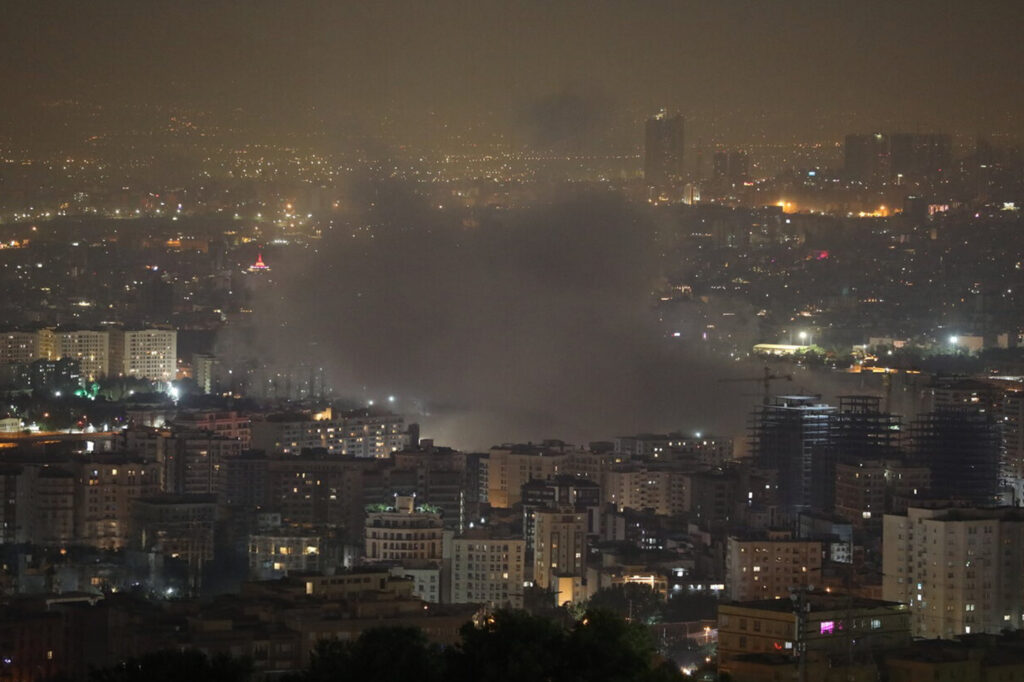
We are in the second week of a joint American–Israeli intensive bombing of the Iranian theocracy. Most of the Iranian military is now inert. The United States and Israel enjoy air supremacy in the skies over Iran. Iran’s daily launching of missiles and drones is dropping to a tenth of the first day launches and becoming of only marginal value to Iran. It either has nearly exhausted its arsenal or is saving it for a last-ditch large strike on the Gulf States, U.S. bases, and Israel.
The Iranian existential strategy of attempting to explode the Middle East by attacking some 12 neighboring nations was a failure. The chaos strategy has led to the surreal images of Arab forces de facto working in concert with Israel against a common Islamic enemy.
The combination of state-of-the-art satellite reconnaissance, coupled with sophisticated drones and missiles that can take out individual targets in bunkers and inside buildings, has led to the destruction of the prewar Iranian theocratic and military leadership. Indeed, any would-be ayatollah or high-ranking general now weighs the chance of being targeted shortly after taking office.
All that said, what are the three scenarios that might mark the end of the war?
The Destruction of the Theocracy and the Establishment of Consensual Government: This is the optimum and hoped-for result and would end the “mowing the lawn” strategy of periodically policing Iran and using military force endlessly to ensure compliance with non-proliferation.
Allowing the regime to survive would ensure that in five to ten years Iran would use its vast oil reserves to rearm and use its now hidden enriched uranium to build several bombs to blackmail the Arab sheikdoms, develop nuclear-tipped missiles with Chinese and Russian help, and eventually attack Israel, the proverbial “one-bomb state.”
Given that the past seven presidents prior to Trump were neither willing to abort the theocracy’s nuclear development nor hold it accountable for murdering and maiming thousands of Americans, it would only be a matter of time after the end of Trump’s tenure, when either a leftist Democrat or isolationist Republican would have signaled Iran that there were no consequences to their grand, nuclear-fueled dreams of dominating the Middle East.
In theory, at some point, if the allies can maintain their systematic destruction of the Iranian military and its weaponry, and scatter the Republican Guard leadership, either some general might step forward in the vacuum to form an ad hoc military junta to negotiate an end to the war on the conditions of ceding power to a coalition civilian government, or at least oversee a secular transitionary government that would arrest the theocrats. Or, if there is not a top-down end to the theocracy, then popular demonstrations and pressures would see the military join the unrest and claim popular support to end the mullahcracy.
In any case, the complete end of the theocracy, followed by a transitional unity government, popular elections, and a duly elected consensual government, would again be the most welcomed result.
The “Venezuelan Solution”: Alternately, there might be a Venezuelan solution—an end to hostilities whose ultimate success we cannot assure, given Venezuela is a work in progress. Israel and the West might live with the emergence of a secular pragmatist who enjoys military support and renounces nuclear weapons development and the subsidizing of terrorist proxies like Hezbollah, Hamas, the Iranian surrogates in Iraq and Syria, and the Houthis. We would pressure him to democratize and form a coalition government, but for the here and now, a “moderate” without past ties to the theocracy could at least follow the dictates of the victors and keep order. And at that point, we could urge democracy but not interfere with the internal politics of Iran—other than to warn that any theocratic reemergence, or efforts to rearm with guided missiles and nuclear weapons, or fund proxy terrorists, would prompt a renewal of the bombing.
Declare Victory and Leave—or the “Stew in Your Own Juice” Strategy: This would be the least viable option. As we continue to bomb, exhaust our arsenals, and witness that the Iranians have adopted a rope-a-dope strategy and they seek to turn popular opinion against the U.S. (in the manner that even anti-Hitler Germans by 1945 nevertheless loathed the Americans and British who were bombing them), we simply claim victory and leave. That is, we honestly report that Iran is inert for five to ten years, longer if we sanction their oil industry, and have prevented a nuclear bomb and defanged proxies—for the immediate future. This “stew in their own juice” would leave whoever emerges to run the country overwhelmed with reconstruction costs, internal divisions, and popular unrest, but the United States and Israel would simply leave it to the organic forces inside Iran to sort it out.
This is the worst option but it might arise if after four to six weeks there are no concessions, no popular uprisings, and no secular transition figure.

Discussion (7)
Join the conversation. Logged in subscribers avoid the Captcha verification and get priority commenting approvals. No vulgarity, links, or code allowed.
If we can hurt the IRGC/regime badly enough, it may give the citizens time to organize and seat a government that is not a death cult. I believe this gives us the best chance of getting out "quickly" while providing the best opportunity for Iran to reform is government.
I think the form of their government shouldn't be our interest, notice that Iraq has not turned out like Japan or Germany. We can have cordial relations with non-democracies, but not when they want to "kill Satan", and they mean us.
Great layout for possible outcomes. Thoughts on this. I think the concept of consensual governance, a.k.a "democracy" is a silly concept in this part of the world. Wherever you have a significant minority or outright majority of Muslim population, democracy exists for exactly one cycle. The Islamist will come into power and there will never be a (true, fair) democratic election again. There is no precedent in history for democracy in certainly the Arab world. The 95% Sunni Tunisia came close years ago, but even that slowly vanished. Iran is very different, but you have 45 years, 2-3 generations that have been programmed for a more religious outlook. Secularism will not come overnight. Even Turkey has backslid over the past two decades. In short, there appears to only be two options: Semi-Secular Autocracy, or Islamic Autocracy. Before the Arab Spring, Syria's Assad was perhaps the most secular autocrat in the region. Jordan's King Hussein comes close to that same label. But both country's military put a lot of time keeping public control.
Dear Alex - Israel is not pushing us into wars. Victor has addressed this in recent articles. The “Israel is pushing us” narrative is another in the long line of antisemitic tropes. VDH has warned us many times about the rise in antisemitism on the left and right and those that are complicit or scared into silence.
How's this as a way of countering the nonsense about perceived "imminent hostilities" being required for attacking Iran. First, there has been a long history of military disasters arising from a dependence on perceived "imminent hostilities" as the requirement for initiating war. In World War II every non German statesman was trying to find an excuse not to see German imminent hostilities. And even after the invasion of Poland, the several month Phony War was due to the inaction of France and England, because they did not see imminent hostilities until they were surprised by sudden hostilities. The U.S. and U.K. saw no imminent hostilities by Japan in the Pacific until sudden hostilities hit them. Second, in all those disasters from waiting for imminent hostilities, we were able to extract enough time to avoid a collapse (although France was not so lucky) and eventually bounce back. If your enemies sudden hostility involved nuclear tipped ballistic missiles, there is no time to recover and regroup. And even if the sudden hostility is merely the threat of nuclear annihilation from a theocracy where martyrdom of their own people is an acceptable, if not desirable, outcome, then you have lost. Hence, the criteria for going to war should not be imminent hostilities. It should be a combination of inevitable (as in a publicly and repeatedly expressed commitment to kill your country) and impending hostilities. That's what Trump faced with Iran.
Perhaps there could be a fourth possibility: regional governments, say the Saudis or especially Erdogan and Turkey step up as 'mediators' to facilitate rebuilding after scenario #1 above. I don't think most Americans want to be tied down over the next decade being actively involved in rebuilding Iran.
VDH - Interesting scenarios. Let's hope it's the first one! I've never been a conspiracy theorist, but I hear more and more about Israel pushing us (USA) into this war. Today's Joe Kent resignation gives that theory some clout. Would love to know your perspective about this theory. I've also heard this about other conflicts -- that Israel actively seeks out these wars and encourages the US to join the fight.